
I wasn’t furious. I wasn’t numb. What I felt, in the middle of my own hardest season, was closer to heartbreak and helplessness, with a strange guilt sitting underneath it for even feeling angry at God in the first place.
Here’s the part that made it worse: some things can’t be undone. No amount of trying gets you back to before. You can’t put the person back in your life, you can’t rewind the moment, and you start to believe you’ll carry this feeling forever. If you’re questioning God after a loss, or losing faith after a death that still feels impossible to accept, I want to tell you what I didn’t hear enough of back then.
You’re not the first person to feel this
Job lost everything in a single day and spent chapter after chapter demanding an explanation he never fully got. Psalm 88 is a prayer that ends in the dark, with no resolution, no “but then I felt better.” It’s still in the Bible. Nobody edited it out for being too honest. Lamentations 3 does the same thing: “I am the man who has seen affliction.” Scripture doesn’t skip the hard part. Even Jesus, on the cross, cried out, “My God, my God, why have you forsaken me?” quoting a psalm of someone who felt abandoned long before Him.
Even Job did. Even Jesus did. Being angry with God after a loss usually isn’t a sign your faith has failed. It’s often a sign that something mattered to you enough to break your heart over.
It’s okay to be angry at God
Grief shook my faith. It’s allowed to. Doubting God after loss doesn’t mean losing Him. It’s still a relationship, it just looks different right now, one that’s honest about being in pain instead of performing peace it hasn’t found yet. If you take nothing else from this, take permission to grieve exactly as you are, anger included.
Some comfort doesn’t comfort
A pastor once told me about the thorn that God sometimes chooses not to heal, the one Paul writes about in 2 Corinthians 12, where he asks three times for it to be removed and God’s answer is “My grace is sufficient for you.” I understand why that passage means something to people. But hearing it in the middle of my own pain felt like being told I would never be healed from what I was carrying. It didn’t comfort me. It left me in despair.
“What doesn’t kill you makes you stronger” didn’t land for me either. Maybe it’s true the first time something hard happens. But when hard things keep stacking up, one loss after another, it doesn’t make you stronger. It makes the next one harder to survive than the last. I don’t think that saying holds up under the weight of a real grief and faith crisis, and I don’t think you need to pretend it does.
This is part of why I built Held in the Waiting, a Christian grief journal, the way I did. A grief journal built for the anger, not around it. 52 weeks that doesn’t ask you to arrive at peace by a certain date. Permission to doubt. Scripture that stays with you in the dark.
Why do bad things happen to good people?
I stopped looking for an answer. Here’s what I found instead: I don’t have one, and I’m wary of anyone who claims they do. Grief rarely shows up as one clean, contained thing either. It’s usually your loss, plus everything that got shaken loose around it, your sense of safety, your trust that things were supposed to work out a certain way. Some questions are meant to be carried, not solved.
What to do when you’re too angry to pray
If you’re mad at God and don’t know what to do with that, you’re not alone, and you’re not required to resolve it before you’re ready. The three sentences that actually helped weren’t explanations. Nobody fixed it for me, nobody argued me out of the anger. What helped was this: “I’ve got you in my prayers.” “I’m here for you, and if there’s anything within my ability to help, I will.” “I’m praying for you all day. I don’t know what this feels like for you, but I’m praying.”
That’s it. That’s the whole comfort. Presence, not answers.
For me, learning to give thanks even in the middle of despair helped too. 1 Thessalonians 5 says to rejoice always, pray without ceasing, give thanks in everything. I started small: thankful for the roof over my head, for the friends and family who showed up for me. I won’t tell you it’s a guarantee, because it isn’t. What I can say is that it helped me deepen my relationship with God through the pain instead of around it, which is closer to not being alone in it than it is to God fixing anything. That’s what grieving without losing your faith actually looks like, not a tidy resolution, just staying close to Him through a season that doesn’t make sense yet.
If you’re angry at God right now, you don’t have to perform forgiveness toward Him before you’re ready, and you don’t have to explain the anger away. You’re allowed to be furious with Him and still show up to talk to Him tomorrow. That’s not weak faith. That might be the realest version there is.
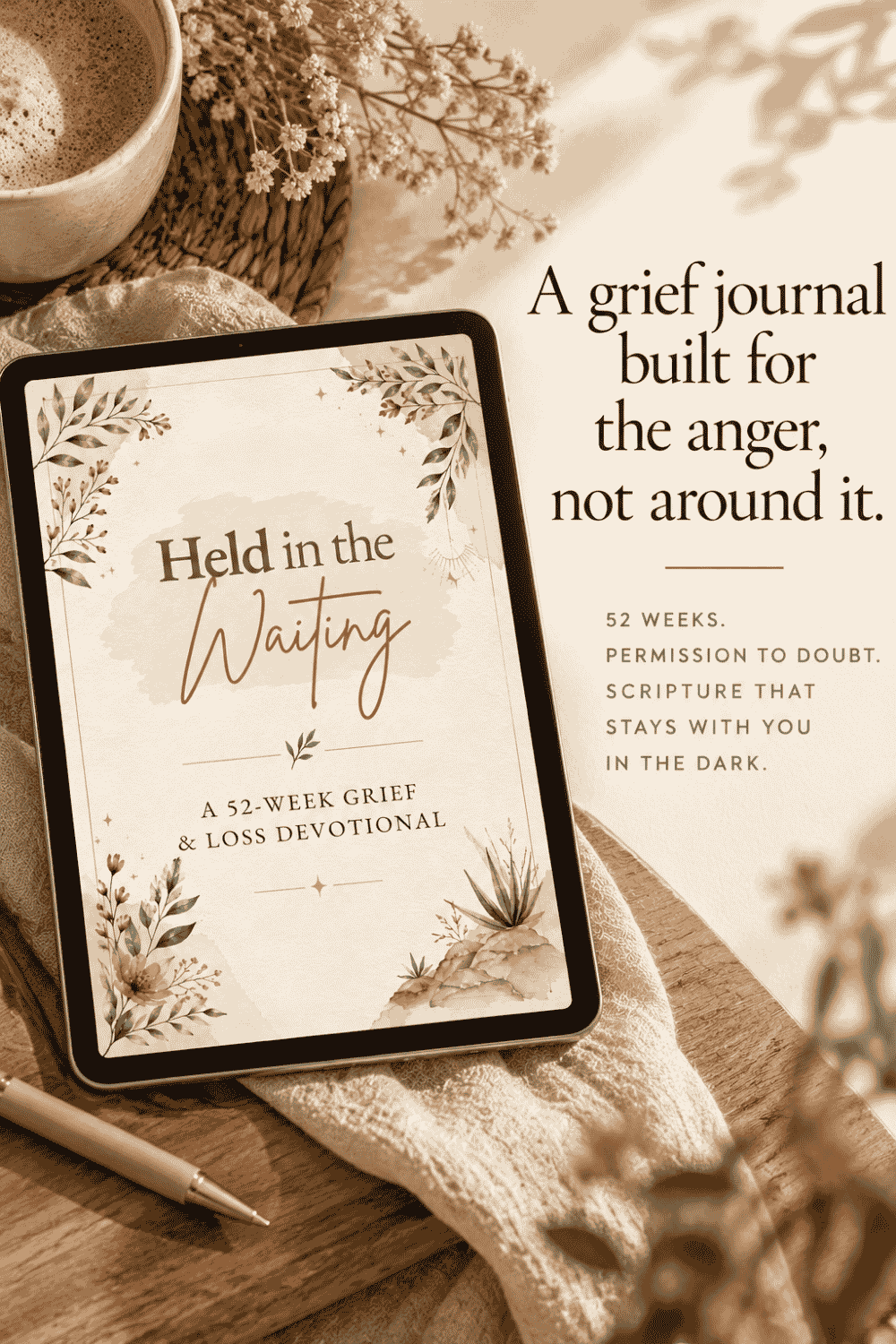
If you want a place to bring all of it, the anger, the guilt, the questions that don’t have answers yet, Held in the Waiting was built for exactly that season.
